
TL;DR: The best payroll software for startups in 2026 is the one that removes compliance work from your plate, not the one that answers questions about it faster. Every major platform now ships AI, but the gap between them is large. Gusto and Justworks mostly offer AI that answers questions and reads your data. Rippling and Deel offer AI that drafts and stages changes for a human to approve. Warp is the only platform in this comparison whose AI agent owns payroll tax compliance end to end: it registers new states, files, resolves tax notices, and reports back. Our pick for venture-backed, multi-state US teams is Warp. For global hiring, Deel.
In this guide, we scored five payroll platforms founders actually use on six criteria, including a new one for 2026: what each platform's AI can do without a human doing the work.
What You Actually Need from Payroll Software
Startup payroll fails in predictable places. 20% of the civil penalties issued to corporations in fiscal year 2025 were due to payroll compliance issues, and most of the preventable penalties we see at Warp trace back to the same three moments: the first hire in a new state, a tax notice that sat unopened, and a correction made after a payroll already ran.
A startup's payroll software needs to handle four things well:
- Multi-state registration and filing. More than half of companies now have employees in multiple states. Each new state means a withholding account, an unemployment account, and often a paid leave program before the first paycheck.
- Local taxes and reciprocity. State coverage is not enough. More than 10,000 local tax jurisdictions in the US, and reciprocity rules change what you withhold for employees who live in one state and work in another.
- Tax notice resolution. Notices arrive by mail weeks after the mistake. Software that just forwards them to you doesn't solve the problem.
- Work that happens without you. This is where AI now matters. The question is not whether a platform "has AI." It is whether the AI finishes the job.
How to Evaluate AI in Payroll Software: The Autonomy Ladder
Every payroll vendor now markets AI. Most of it sits on a single spectrum, and where a product sits on that spectrum decides how much of your week it gives back. We use four levels:
| Level | What the AI does | Who still does the work | Example |
|---|---|---|---|
| 1. Answers | Explains policies, answers "how do I" questions, reads your data | You | A chat assistant that tells you how to run an off-cycle payroll |
| 2. Drafts | Builds reports, prepares changes, flags anomalies for review | You, faster | An assistant that stages a bonus run for you to approve |
| 3. Acts with approval | Executes changes inside the platform after a human confirms | You approve, it executes | An agent that places a laptop order once a manager clicks approve |
| 4. Owns the workflow | Runs complete workflows on a trigger or schedule, within set permissions, and escalates only what needs a human | The agent, with an audit log | An agent that registers a new state, sets up withholding, and closes a tax notice without being asked |
Levels 1 and 2 make a person somewhat faster at work they still own. In Warp's experience, that gain is around 20%. Level 4 removes the work. The tradeoff is trust: an agent that moves payroll needs tight permissions, an audit trail, and a way to undo what it did. So when we scored AI capabilities below, we looked at five things: autonomy level, depth in payroll and tax specifically, governance (permissions, audit logs, rollback), whether the AI runs without being prompted, and whether it is generally available or a paid add-on.
Payroll Software for Startups: 2026 Scorecard
We weighted multi-state compliance most heavily because it is the most expensive failure point for distributed startups. AI capabilities is new this year at 20%.
| Criteria (weight) | Warp | Rippling | Gusto | Deel | Justworks |
|---|---|---|---|---|---|
| Multi-state compliance automation (25%) | 10 | 7 | 5 | 4 | 7 |
| AI agent capabilities (20%) | 9 | 8 | 6 | 7 | 3 |
| Tax accuracy and filing (20%) | 9 | 8 | 7 | 6 | 8 |
| Support quality (15%) | 10 | 5 | 5 | 6 | 7 |
| Benefits for distributed teams (10%) | 9 | 8 | 6 | 4 | 9 |
| Pricing transparency (10%) | 9 | 4 | 8 | 5 | 7 |
| Weighted Score | 9.4 | 6.9 | 6.0 | 5.4 | 6.6 |
How we scored AI agent capabilities: 1 to 3 for question-answering and read-only data access, 4 to 6 for drafting and approval-gated actions in limited areas, 7 to 8 for broad approval-gated actions or proactive monitoring across HR, IT, and payroll, and 9 to 10 for agents that own complete payroll and tax workflows with configurable autonomy, audit trails, and rollback. Warp scores a 9 rather than a 10 because Warp Agent: Routines is in early access as of this update.
AI Capabilities Compared: What Each Platform's AI Can Do
| Warp | Rippling | Gusto | Deel | Justworks | |
|---|---|---|---|---|---|
| Named AI Products | Warp Agent with Routines; state registration and tax notice agents | Rippling AI; Rippling Helpdesk; Plugins, Skills, and Automations | Gus; Assisted Payroll Prep; Gusto in ChatGPT, Claude, and Slack | Deel AI; AI Workforce (Hiring, Onboarding, Payroll AI, PTO, Custom agents) | Justworks MCP |
| Highest autonomy level | 4: owns workflows | 3: acts with approval | 2 to 3: mostly answers and flags; payroll runs via chat integrations for eligible customers | 3: acts within approval thresholds | 1: reads and answers |
| Opens state tax accounts | Yes, automatically | No | No | No | Yes, via PEO, not AI |
| Resolves tax notices | Yes, agent resolves on your behalf | No, forwarded to you | No, forwarded to you | No | Handled by PEO team |
| Runs without a prompt | Yes, event and schedule triggered | Yes, via Automations | Payroll anomaly flags | Yes, for proactive monitoring | No |
| Governance | Inherits user permissions; per-workflow autonomy; identity, rationale, and rollback on every action; hard limits on money movement | Inherits roles and permissions; changes follow company approval chains; Agent Identity Management | Actions require owner approval | Works within user-defined rules and approval thresholds | Read-only access for admins |
| Human escalation | Warp Tax Specialists | Standard support | Standard support | Standard support | PEO Team |
The 5 Best Payroll Platforms for Startups
1. Warp: Best for Startups That Want Compliance Handled
Best for: Pre-seed through IPO, with US employees in multiple states
Pricing: Starter: $35/person/month plus $89 platform fee (up to 3 states). See more at Warp pricing.
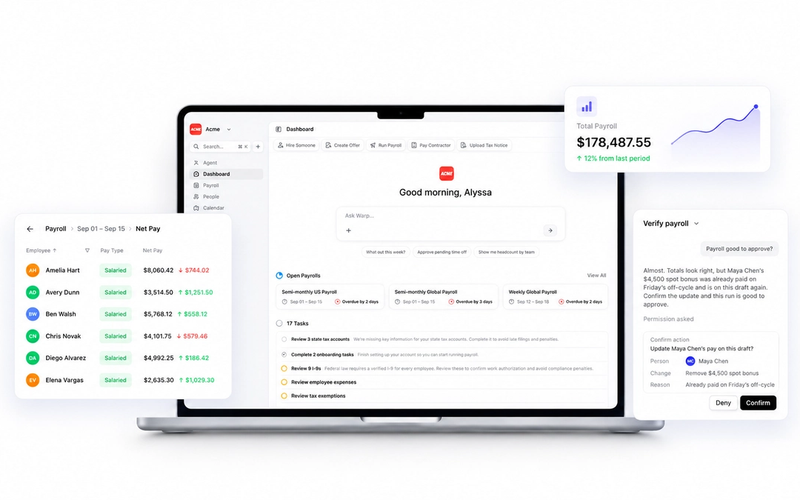
Warp is the only AI-native HR & Payroll platform built for ambitious companies. Instead of clicking through clunky dashboards or .gov websites for taxes, Warp's AI agents open every state tax account, file every payroll form, and resolve every tax notice, automatically.
AI capabilities: Warp Agent
Warp started in 2023 with payroll tax compliance, the hardest workflow to hand to software, and has run agents on it since. In 2026, Warp extended that model across people operations with Warp Agent, an always-on agent that takes complete workflows off your team's plate.
Warp Agent works through Routines: jobs it owns and runs when something happens in your company or on a schedule. Most come turned on by default. When an offer is signed, the agent registers the company in the new state, sets up payroll, enrolls benefits and 401(k), orders the laptop, creates Google and Slack accounts, and sends the first-day message. When a tax notice arrives, it resolves it. Before every payroll, it checks for variances. Teams can also write their own Routines in plain language, such as "send every new hire a 30-day check-in and summarize it for their manager."
What separates this from a chat assistant is the control model:
- Per-workflow autonomy. Each company chooses, workflow by workflow, whether the agent recommends, acts after approval, or acts on its own. Most customers start with approval and expand as they review the log.
- Every action is accountable. Each action carries an identity, a scope, a written rationale, and a rollback.
- Same permissions as the person it acts for. An exec, a Head of People, and a sales rep get different scopes, and the agent cannot see or do anything the person it is acting for cannot.
- Hard limits on money movement that the agent itself cannot change.
- Human escalation. Some tax agencies still require a person with Power of Attorney on the phone. In those cases, the agent brings in a Warp tax specialist, who makes the call and closes the case.
Compliance strengths
- Automatic state tax registration in all 50 states, with most registrations completing in 5 to 10 business days
- Coverage for 10,000+ local tax jurisdictions, reciprocity agreements, and every active state paid leave program
- A Tax & Compliance dashboard that shows every jurisdiction you operate in, its status, and a log of what Warp automated there
- Native IT management (Warp IT, $15/person/month add-on) for identity, access, and device management
Where Warp is not the right fit: Warp is built for US payroll with contractor payments in 200+ countries. If you need to employ full-time staff abroad through an Employer of Record, pair it with an EOR or look at Deel.
2. Rippling: Best for 500+ Employee Companies
Best for: Enterprise companies above 500 employees that want HR, IT, and finance in one system
Pricing: Quote-based, typically annual contracts
Rippling has the deepest cross-functional workflow automation in this list and has shipped AI quickly in 2026.
AI capabilities: Rippling AI, Helpdesk, and Automations
Rippling AI answers questions, writes reports and SQL from your data, and prepares changes such as bonus runs and off-cycle payrolls. Rippling states that it inherits your existing roles and permissions and requires explicit human confirmation before executing a change, so payroll changes are staged for review rather than executed on their own. In August 2026, Rippling launched Rippling Helpdesk, an agentic IT support product that resolves access requests, password resets, and device issues with audit logging, and an AI Governance Suite with Agent Identity Management. In September 2026, it added Plugins, Skills, and Automations so AI can run recurring tasks under governance.
Where it falls short for startups: Rippling's AI is strongest in IT and analytics. We found no Rippling AI capability that registers state tax accounts or resolves tax notices on your behalf, which are the two most expensive compliance tasks for a growing startup. Support ratings trail the rest of this list, and pricing is not published.
3. Gusto: Best Entry Point for Single-State Teams
Best for: Small teams in one state that want a simple interface and accountant integrations
Pricing: Simple $49/month plus $6/person (single state)
Gusto remains the simplest place to run a first payroll, and its accounting firm integrations are strong for companies that plan to stay small.
AI capabilities: Gus, Assisted Payroll Prep, and chat integrations
Gus is Gusto's AI assistant on web and mobile. It answers payroll, benefits, and compliance questions in plain language, links to source articles, and hands off to human support. Gusto's help center currently describes Gus as an information tool that does not run payroll or change data. Assisted Payroll Prep flags unexpected payroll amounts and irregular timecards before you submit. Through Gusto in ChatGPT, Claude, and Slack, customers can query payroll data, and eligible customers can run payroll directly from those tools. Gusto also offers an AI-powered R&D tax credit checker.
Where it falls short for startups: Gusto's AI helps answer questions about compliance work, but the work is still yours. Multi-state payroll requires the Plus plan, some state registrations are not fully automated, and tax notices are just forwarded to you. Growing teams often outgrow it at the second or third state.
4. Deel: Best for Global-First Teams
Best for: Startups hiring full-time employees in multiple countries
Pricing: Varies by service (EOR, contractor, US payroll)
Deel operates as an Employer of Record in 150+ countries and is the clearest choice if most of your team sits outside the US.
AI capabilities: Deel AI and AI Workforce
Deel AI, expanded at Deel's March 2026 event, continuously monitors for anomalies, flags risks, and surfaces missing information without being asked. The AI Workforce suite includes a Hiring Agent, an Onboarding Agent that proposes equipment and places orders, Payroll AI that catches anomalies before a cycle starts and traces changes to their source, a PTO Agent that checks policy, local law, and approvals, and a Custom Agent you train on your handbook. Deel says its agents work within user-defined rules and approval thresholds, with your team controlling decisions.
Where it falls short for startups: Deel's AI is strong at monitoring and explaining, and it is sold as a paid, usage-based add-on. For US-only teams, Deel's domestic payroll costs more than purpose-built US platforms and its state registration and notice handling are less automated.
5. Justworks: Best for Enterprise-Grade Benefits Through a PEO
Best for: Startups competing for talent that want large-group health insurance rates
Pricing: Payroll $50/month plus $8/person. PEO Basic $79/person/month.
Justworks is a Professional Employer Organization. Through co-employment, it gives small companies access to benefits rates usually reserved for large employers, and its PEO team handles much of the compliance work.
AI capabilities: Justworks MCP
In July 2026, Justworks launched the Justworks MCP, which connects your account to AI tools like Claude and ChatGPT so admins can ask about headcount, payroll history, time-off balances, and deductions in plain language. It is read-only: it answers questions about your data but does not take actions.
Where it falls short for startups: Justworks relies on people, not AI, for compliance, which works but costs two to three times more per employee than software-only platforms. The PEO model also limits employer flexibility on plan design.
Why Payroll Automation Isn't the Risk You Think It Is
The most common objection we hear to AI in payroll is that it is too sensitive to automate. We think the opposite is true. Ernst & Young found that payroll teams at 1,000-employee organizations spend 29 aggregate workweeks a year fixing errors. Most of those errors are rule-based: a missed withholding account, a wrong local rate, a deduction entered twice. Rules are exactly what software applies consistently.
The real risk is automation without controls. Before you turn on any AI agent in payroll, ask the vendor four questions:
- Does the agent inherit the permissions of the person it acts for, or does it have its own broader access?
- Can you set autonomy per workflow, starting with approval and expanding later?
- Does every action have a logged rationale and a way to reverse it?
- Are there hard limits on money movement the agent cannot change?
If the answer to any of these is no, keep the AI at Level 2 until it is yes. For a deeper look at where manual processes go wrong, see 10 payroll mistakes that cost startups thousands.
The Payroll Features That Matter for Remote Teams
Remote hiring is where payroll software earns its price. An employee who moves from New York to Colorado creates new withholding, unemployment, and paid leave obligations, often without telling you in advance. Look for:
- Automatic state registration triggered by a new hire or address change, not a support ticket
- Reciprocity and convenience-of-employer rule handling for employees who cross state lines
- Local tax coverage beyond state level
- Mandatory paid family and medical leave administration in the 13+ states with active programs
- Proactive tax notice resolution rather than forwarding
Our multi-state payroll compliance guide and our breakdown of remote employees and state tax nexus cover the rules state by state.
How to Choose: The Decision Framework
- US team across multiple states, growing fast, want compliance off your plate: Warp
- Most employees outside the US: Deel
- 500+ employees, want HR, IT, and finance in one enterprise system: Rippling
- One state, cost is the priority: Gusto
- Benefits are your main recruiting lever: Justworks
For AI specifically: if you want AI that answers questions, every platform here qualifies. If you want AI that stages work for you to approve, look at Rippling or Deel. If you want AI that finishes payroll and tax work on its own, with controls you set, Warp is the only option in this comparison.
So, what’s the best payroll software?
The best payroll software for startups in 2026 is the one that takes the operational work away, not the one that helps you do it faster. AI has made that distinction visible. Chat assistants and data connectors are useful, but they leave the state registrations, filings, and tax notices on your desk. Warp's agents own that work, with permissions, audit trails, and rollback built in, with Tax Specialists, Benefits Advisors, and dedicated Account Managers for the moments a person should step in.
Frequently Asked Questions
What is the best payroll software for startups in 2026?
Warp is our top pick for venture-backed startups with US employees in multiple states. It automatically registers state tax accounts, resolves tax notices through AI agents, and includes a dedicated Account Manager. Deel is the better choice for mostly international teams, and Rippling fits companies above 100 employees that want one enterprise system.
Which payroll software has the best AI?
It depends on what you want the AI to do. Gusto's Gus and the Justworks MCP answer questions and read your data. Rippling AI and Deel's AI Workforce draft, flag, and stage changes within approval rules. Warp Agent is the only one in this comparison that owns payroll tax workflows end to end, including state registration and tax notice resolution.
Is it safe to use AI for payroll?
It is safe when the AI operates under the same controls you would require of a person with payroll access. Look for agents that inherit user permissions, let you set autonomy per workflow, log a rationale for every action, support rollback, and have hard limits on money movement. Most teams start with approval required and expand autonomy after reviewing the logs.
How much does payroll software cost for a startup?
Gusto starts at $49/month plus $6 per person for single-state payroll and $80/month plus $12 per person for multi-state, with additional fees to handle state registrations. Warp starts at $35 per person plus an $89 platform fee, with all-50-state compliance and AI tax notice resolution on Pro at $50 per person plus $129. Justworks PEO plans run $79 to $124 per person per month.
Can AI payroll software resolve tax notices?
Most platforms forward tax notices to you. Warp's agents triage and resolve notices on your behalf, and bring in a Warp tax specialist when an agency requires a person with Power of Attorney. PEOs like Justworks handle notices through their own staff.
Can I switch payroll providers mid-year?
Yes. A mid-year switch typically takes one to two weeks when the new provider imports year-to-date wage and tax data so W-2s stay accurate. Warp offers free white-glove migration.