
If your company has employees working in more than one state, you are running multi-state payroll. With 19 states raising minimum wages on January 1, 2026, three new PFML programs launching, and pay transparency laws now active in 17 states, multi-state compliance has never been more complex.
This guide covers what triggers obligations in a new state, tax withholding rules, 2026 rate changes, and penalties that can reach $250,000 per violation.
What Is Multi-State Payroll?
Multi-state payroll is the process of managing payroll for employees who work in, or live in, more than one state. It covers calculating and withholding the correct taxes, remitting payments, and complying with each state's wage, benefits, and reporting requirements.
Multi-state payroll applies if:
- You have office locations in more than one state
- You employ remote workers in a different state than your HQ
- Employees travel across state lines for work
- An employee has moved to a new state while keeping their job
What Triggers Multi-State Payroll Obligations?
One employee in a new state triggers full tax obligations. Unlike sales tax (which often has a $100K+ threshold), employment tax nexus has a zero-dollar threshold. A single remote worker in California or New York means you need to register immediately.
If someone works from their apartment in Austin on Monday, your company has Texas obligations by Monday.
When you establish nexus, register with three agencies within 15-20 days:
- State Department of Revenue for income tax withholding (41 states + D.C.)
- State Department of Labor for unemployment insurance (all 50 states)
- Workers' compensation insurance before employees start working
Nine states have no income tax: Alaska, Florida, Nevada, New Hampshire, South Dakota, Tennessee, Texas, Washington, and Wyoming. But you still need SUI and workers' comp.
Four states are monopolistic for workers' comp (must buy from state fund): North Dakota, Ohio, Washington, and Wyoming.
Best practice: Start registrations 60 days before your first payroll in a new state.
Understanding Multi-State Payroll Taxes
Multi-state payroll taxes have multiple layers, and understanding how they interact is essential for staying compliant.
Federal Payroll Taxes
Federal obligations are the same regardless of where employees work:
- Social Security: 6.2% each (employer + employee), up to $184,500 wage base in 2026
- Medicare: 1.45% each, plus 0.9% employee surcharge on earnings over $200,000
- FUTA: 6.0% on first $7,000 per employee (typically reduced to 0.6% with FUTA credit)
State Income Tax Withholding
The default rule: withhold for the state where work is physically performed. When employees live in one state and work in another, you may need to withhold for both.
State Unemployment Insurance (SUI)
SUI rates and wage bases vary dramatically:
- New employer rates range from 1.0% (South Carolina) to 3.4% (New York)
- Five states use the federal minimum $7,000 wage base (AR, CA, FL, LA, TN)
- Washington taxes wages up to $78,200
- California remains a FUTA credit reduction state (~$84 per employee in added federal tax)
Local Taxes
Some cities add their own layer. For example:
- Philadelphia: 3.43% to 3.74%
- Portland area: up to 4.5% for high earners
- NYC: has its own income taxPaid Family and Medical Leave: 13 States Plus D.C.
Paid Family and Medical Leave: 13 States Plus D.C.
PFML programs require employers and/or employees to contribute a percentage of wages to fund paid leave for qualifying events.
New in 2026:
- Minnesota: Contributions and benefits started January 1, 2026
- Delaware: Benefits started January 1, 2026 (contributions began 2025)
- Maine: Benefits start May 1, 2026Washington's rate jumped 23% (from 0.92% to 1.13%). California eliminated its wage cap entirely.
IRS update: Revenue Ruling 2025-4 clarifies that employer-funded medical leave benefits are subject to FICA/FUTA (family leave is not affected).
Contribution rates vary widely:
| State | 2026 Rate | Who Pays | Max Weekly Benefit |
|---|---|---|---|
| California | 1.3% | 100% employee | $1,765 |
| Colorado | 0.88% | 50/50 | $1,381 |
| Connecticut | 0.5% | 100% employee | $1,016 |
| Delaware (new) | 0.8% | 50/50 | $900 |
| Maine (new) | 1.0% | 50/50 | $1,199 |
| Massachusettes | 0.88% | 48% employee / 52% employer | $1,230 |
| Minnesota (new) | 0.88% | 50/50 | $1,423 |
| New Jersey | 0.42% (combined TDI/FLI) | Mostly employee | $1,119 |
| New York | 0.432% | 100% employee | $1,229 |
| Oregon | 1.0% | 50/50 | $1,637 |
| Rhode Island | 1.1% | 100% employee | $1,103 |
| Washington | 1.13% | 71% employee / 29% employer | $1,647 |
| D.C. | 0.75% | 100% employer | $1,190 |
| Maryland | 50/50 | 0.45% | $2,031 |
Pay Transparency: 17 States and Counting
Five years ago, only Colorado required salary ranges in job postings. Today, 17 states plus D.C. have pay transparency laws.
Example penalties:
- NYC: Up to $250,000 for willful violations ($125,000 standard max)
- Colorado: $500 to $10,000 per violation
- California: $100 to $10,000 per posting
Best approach: Adopt the strictest standard as your universal baseline for every job posting.
Workers' Compensation Requirements
Nearly every state requires workers compensation coverage before an employee's first day. Unlike health insurance, workers' comp is not optional.
Some penalties for non-compliance:
- California: $10,000 to $100,000 (misdemeanor)
- New York: $2,000 per 10-day period without coverage
- Pennsylvania: Third-degree felony for intentional non-compliance
Common Challenges With Multi-State Payroll
Keeping up with changing laws - The 2026 changes alone include 19 minimum wage increases, 3 new PFML programs, 8 state income tax cuts, and evolving pay transparency rules.
Employee relocations - When an employee moves (even temporarily), it triggers new obligations. Many employers find out after the fact.
Multiple filing deadlines - Each state has its own calendar. Operating in 10+ states means deadlines multiply fast.
Reciprocity complexity - Determining correct withholding for employees living in one state and working in another requires checking reciprocity agreements and exemption forms.
Varying wage and hour laws - California requires daily overtime after 8 hours. Most states only require overtime after 40 hours/week.
The Penalty Landscape: What Non-Compliance Actually Costs
IRS Deposit Penalties
Penalties escalate based on how late you are:
- 2% - 1 to 5 days late
- 5% - 6 to 15 days late
- 10% - 16+ days late (before IRS notice)
- 15% - 10+ days after IRS notice
Trust Fund Recovery Penalty: 100% personal liability on founders, officers, and bookkeepers for unpaid withholdings. Not dischargeable in bankruptcy.
Worker Misclassification
- California: $5,000-$15,000 per violation (willful); $10,000-$25,000 for pattern/practice
- Massachusetts: Up to $25,000 + 1 year imprisonment, treble damages available
- New Jersey: Lyft paid $19.4 million settlement in 2025
Make sure you know if you should classify someone as a full time employee or a contractor to avoid these penalties.
W-2 Late Filing
- $60 per W-2 filed within 30 days of due date
- $130 per W-2 filed after 30 days
- $340 per W-2 filed after August 1
New Hire Reporting
- Federal: $25 per employee ($500 if conspiracy)
Tips for Managing Multi-State Payroll
- Start registrations 60 days early - Processing times vary, and some agencies are slow
- Track where employees actually work - Not just where they "live" on paper
- Adopt the strictest standard - Easier to manage one policy than 15 different ones
- Automate tax calculations - Manual multi-state payroll is a recipe for errors
- Audit quarterly - Review registrations, rates, and employee locations
- Keep detailed records - Your best defense if audited
How Warp Keeps You Compliant Across Every State
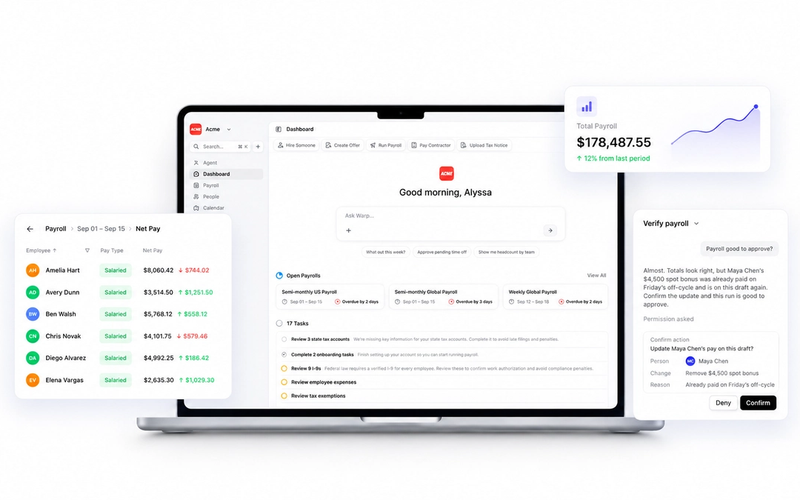
Warp is the only AI-native HR and payroll platform built for startups. Instead of clicking through clunky dashboards or .gov websites, Warp's AI agents:
- Open every state tax account automatically
- File every payroll form
- Resolve every tax notice
- Enroll you in state PFML programs automatically
Every company gets a dedicated Account Manager and Benefits Advisor included. No hours on hold with tax agencies. No compliance guesswork.
Thousands of fast-growing startups trust Warp to stay compliant while they scale. See how Warp works →
Frequently Asked Questions
Do I need to register in every state where I have a remote employee?
Yes. Even one employee triggers full employment tax nexus. Register within 15-20 days of first wages paid.
How do I know which state to withhold for?
Withhold for the state where work is performed. Check for reciprocity agreements if the employee lives elsewhere. With reciprocity, you only withhold for the residence state.
What are the biggest compliance risks in 2026?
- Missing state tax registrations when hiring remotely
- Worker misclassification in ABC-test states (CA, MA)
- Failure to enroll in PFML programs (13 states + D.C.)
- Not updating withholding tables for 2026 changes
What happens if I miss a registration deadline?
You face retroactive tax assessments plus interest, potential loss of 5.4% FUTA credit (raising federal unemployment tax from 0.6% to 6.0%), state penalties, and possible workers' comp violations (criminal in most states).
Which states are most complex?
California, New York, and Massachusetts consistently rank highest. California has the strictest worker classification (ABC test), industry-specific minimum wages, and $25,000 misclassification penalties. NYC adds its own income tax plus pay transparency fines up to $250,000.
Can one payroll system handle all 50 states?
Yes, but not all platforms handle multi-state compliance equally. Many require manual registration and filing. Warp's AI agents handle automatic state tax registration, filing, and notice resolution across all 50 states. See Warp's pricing →